Masai Ujiri
From Nigeria to the Raptors’ front office, Masai Ujiri engineered a championship and built Giants of Africa, helping position Africa as basketball’s next growth frontier.
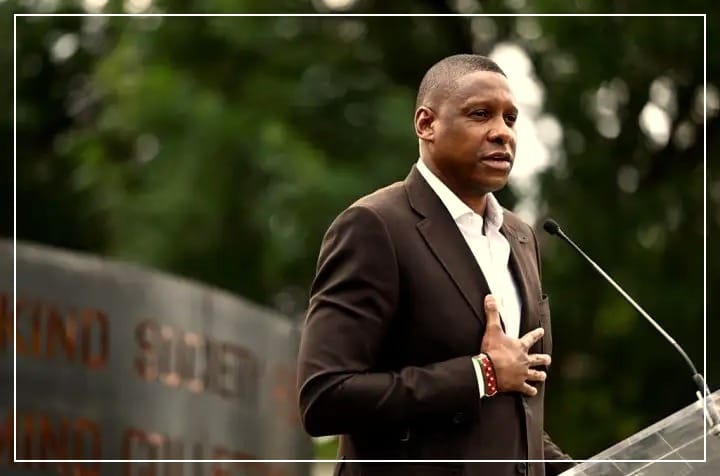
Masai Ujiri - The Architect of Winning and the Diplomat of Global Basketball
From Zaria to the Championship Stage
Masai Ujiri did not inherit power in basketball.
He built proximity to it.
Born in Zaria, Nigeria, and raised partly in both Nigeria and the United Kingdom, Ujiri’s early exposure to the game did not resemble the American AAU pipeline. His pathway was global, fragmented, and unconventional.
He played professionally in Europe before transitioning into scouting. That pivot would change the trajectory of modern basketball.
Because Masai did not just scout players.
He scouted markets.
He understood early that basketball was not just an American sport exported globally.
It was a global sport waiting to be fully integrated.
The Executive Architect
Before Toronto, before the championship, before the parade - Ujiri built his reputation as a talent evaluator and executive riser.
He worked within the international scouting ecosystem before joining the front office ranks in the NBA. His tenure with the Denver Nuggets elevated him into league-wide respect. But it was his move to the Toronto Raptors that defined his executive identity.
In Toronto, Ujiri did something that separates operators from caretakers.
He took risks.
The 2018 trade that sent franchise icon DeMar DeRozan to San Antonio for Kawhi Leonard was one of the boldest executive decisions of the decade. It was cold. It was calculated. It was structural.
And it resulted in Toronto’s first NBA championship in 2019.
Championships validate executives.
But architecture defines them.
Ujiri did not build that team through tanking cycles alone. He leveraged scouting, international talent, development systems, and aggressive trade strategy.
He saw inefficiencies and moved on them.
That is executive discipline.
The Diplomat of Global Basketball
Masai’s influence does not end in the front office.
Through Giants of Africa, the organization he founded in 2003, Ujiri has built one of the most important basketball development pipelines on the continent.
Giants of Africa has hosted camps across multiple African nations, reaching thousands of young players. But more importantly, it created exposure.
Exposure to coaching.
Exposure to training infrastructure.
Exposure to belief.
The NBA’s increasing African presence - from players like Pascal Siakam to Joel Embiid to OG Anunoby to countless others - reflects a broader structural shift. Ujiri is not solely responsible for that wave, but he has been one of its most visible connectors.
Basketball in Africa is no longer novelty. It is emerging infrastructure.
And Masai sits at the intersection.
The Bridge Between Continents
The NBA’s future is international.
That is not theory. That is economics.
- International media rights continue expanding.
- Global merchandising markets grow annually.
- Youth participation outside the United States rises steadily.
Africa represents one of the most under-leveraged growth corridors in global basketball.
Ujiri embodies that bridge.
He is:
- Nigerian-born.
- European-trained.
- NBA-developed.
- Institutionally powerful.
That combination matters.
As the NBA expands initiatives like Basketball Africa League (BAL), invests in grassroots programming, and seeks deeper international media penetration, executives who understand both American league structure and African opportunity become strategic assets.
Masai does not just speak about global growth.
He represents it.
Winning as Leverage
Winning gives credibility.
Credibility gives influence.
Influence creates access.
After the Raptors’ 2019 championship, Ujiri’s institutional power increased dramatically. He transitioned into President and Vice Chairman roles within the organization, solidifying long-term leadership influence.
He is not a coach.
He is not an owner.
But he operates at ownership proximity.
In modern sports organizations, proximity to ownership often matters more than title.
He shapes direction.
He shapes culture.
He shapes global positioning.
That is power without headlines.
Talent Pipeline and African Impact
Let’s be clear.
Africa’s basketball explosion is not a single-person story.
It is the product of:
- Improved global scouting
- Digital exposure
- NBA development initiatives
- European league infrastructure
- Youth training programs
But Masai has been a consistent advocate for African visibility inside league rooms.
He has publicly emphasized the continent’s talent base, its population growth, and its youth demographics.
Africa is young.
Basketball is scalable.
That is not romanticism. It is demographic mathematics.
If the NBA’s long-term expansion includes deeper continental integration, Masai is already positioned as both cultural and structural intermediary.
Net Worth and Institutional Standing
Public estimates place Masai Ujiri’s net worth somewhere in the range of $20–30 million, though such figures are speculative and not formally verified. Executive compensation structures, bonuses, equity positions, and private assets are rarely transparent in full.
But net worth does not capture executive gravity.
Masai’s real value lies in:
- Decision-making authority
- Organizational leverage
- Global credibility
- Cross-continental access
He may not own the franchise.
But he influences its direction.
That is capital of a different form.
The Risk Tolerance Factor
The Kawhi trade defined his willingness to accept short-term backlash for long-term gain.
Executives often protect stability.
Masai chased ceiling.
That is rare.
In business terms, he chose volatility with upside rather than safety with stagnation.
That championship banner validated the calculus.
The Long View
Masai Ujiri’s legacy will likely extend beyond wins and losses.
It may be measured in:
- African talent integration
- Basketball diplomacy
- Institutional leadership
- Cross-border economic growth
As the NBA becomes more globally distributed, executives who understand multi-continent ecosystems become invaluable.
Masai is already operating in that future.
The Tall Cotton Coda
At The Tall Cotton, we document those who build beyond spotlight.
Masai Ujiri built a championship team.
He built a continental pipeline.
He built credibility across borders.
He is not the loudest man in the room.
He is often the most consequential.
Culture.
Capital.
Control.
Masai Ujiri is building all three - across continents.