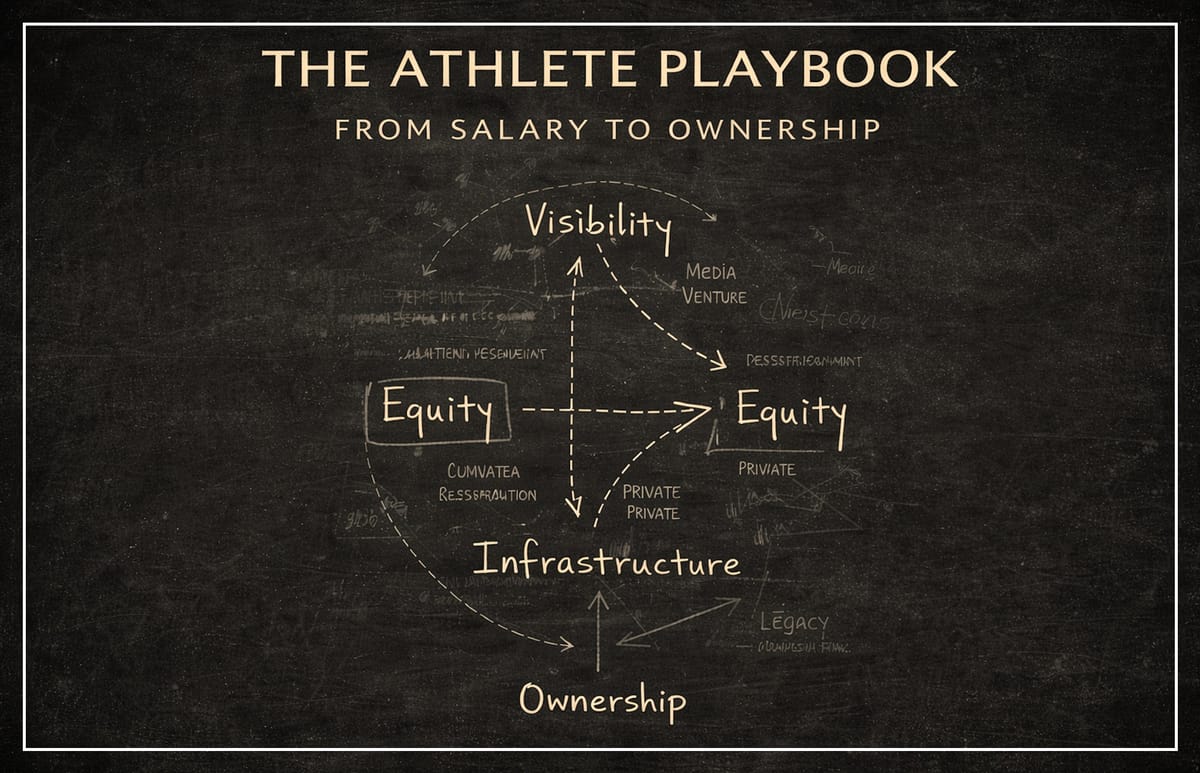
The Athlete Playbook: From Salary to Ownership
A framework for how athletes and modern operators turn income into ownership through equity, infrastructure, and long-term capital allocation.
How Athletes Turn Salary Into Ownership and Billion-Dollar Brands
Most athletes earn millions.
Very few build something that lasts.
Contracts are large. Endorsements are visible. The lifestyle is easy to recognize. But when the career ends, the difference becomes clear. Income was never the destination. It was the starting point.
For decades, the model was straightforward. Play well, get paid, sign endorsement deals, and manage what follows. Some turned that into stability. A smaller group turned it into scale. Most never moved beyond the cycle.
What has changed is not the opportunity. It is the approach.
A different class of athlete has emerged. One that sees contracts as capital, visibility as leverage, and time as something to deploy with intention. They are not simply participating in the system. They are learning how to position within it.
And when you step back, the pattern becomes difficult to ignore.
The same decisions appear across different sports, different backgrounds, and different industries. The same principles show up whether the outcome is a media company, an investment portfolio, or a global brand.
This is not a formula.
It is a playbook.
And while it starts with athletes, it extends beyond them. The principles that drive ownership, scale, and longevity are not limited by sport. They are defined by how individuals think about control, capital, and time.
Once you see it, you start to recognize it everywhere.
1. Turn Visibility Into Leverage
Fame is not the asset. It is the access point.
Most athletes monetize visibility directly. Commercials, endorsements, appearances. These are logical moves. They generate immediate income and reinforce brand recognition.
But the more disciplined operators use visibility differently. They treat it as a key that unlocks rooms that were previously inaccessible.
Kevin Durant is a clear example. Early in his career, he was already one of the most recognizable players in the league. That visibility could have been fully consumed by endorsements alone. Instead, he and Rich Kleiman built Thirty Five Ventures. That platform allowed him to invest in companies, produce media, and participate in deals that extended far beyond basketball.
The visibility got him in the room. The structure allowed him to stay.
LeBron James followed a similar path, but at an even larger scale. Through SpringHill, he built a media company designed to own intellectual property and distribution. Projects like Space Jam and The Shop were not just content. They were vehicles for ownership, storytelling, and long-term value creation.
The shift is subtle but critical.
Visibility is temporary.
Leverage extends it.
Athletes who understand this stop asking what a moment pays. They start asking what it leads to.
2. Choose Equity Over Endorsement
The traditional endorsement model is built on certainty. A company pays an athlete a fixed amount in exchange for attention. The athlete promotes. The company owns the upside.
It is clean. It is predictable. It is limited.
The shift toward equity changes the equation entirely.
Jaylen Brown made this visible in real time. After signing one of the largest contracts in NBA history, he had every opportunity to secure another major endorsement deal. Instead, he chose to build 741 Performance. That decision moved him from spokesperson to owner. It placed him in control of product, positioning, and long-term value creation.
That is a different role.
Kevin Durant has approached this from another angle. Through his investment activity and strategic partnerships, he has consistently aligned himself with equity participation rather than purely transactional deals. The goal is not just income. It is ownership within the companies themselves.
Serena Williams expanded this model further through Serena Ventures. Rather than simply endorsing brands, she invested in them. Over time, she built a portfolio of early-stage companies, many of them led by women and founders of color. This is not passive participation. It is active capital allocation.
Rihanna represents the most scaled version of this approach. Fenty Beauty was structured as a partnership, but with meaningful ownership retained. As the company grew, so did her equity position. The same pattern appears with Savage X Fenty. These are not endorsements. They are enterprises.
The difference becomes clear over time.
An endorsement pays for presence.
Equity pays for ownership.
One is finite. The other compounds.
This is where discipline shows up. Equity requires patience, conviction, and a willingness to accept uncertainty. It asks for a longer timeline.
But it is also where exponential outcomes begin.
3. Build Infrastructure, Not Just Income
Income is a result. Infrastructure is a system.
The highest level of wealth is rarely built on isolated deals. It is built on platforms that generate opportunities repeatedly.
Roc Nation is a clear example of this. It began in music, but expanded into sports, media, and brand partnerships. It does not rely on a single vertical. It operates as an ecosystem that produces value across multiple lanes.
Klutch Sports operates in a similar way within athlete representation. It is not just negotiating contracts. It is shaping market dynamics, influencing deal structures, and expanding into new sports and business areas. The agency itself becomes a power center.
This concept is not limited to sports.
Cathy Hughes built Urban One into one of the largest Black-owned media companies in the United States. She did not rely on a single station or market. She built a network. That network created recurring revenue, influence, and long-term enterprise value.
Sheila Johnson followed a parallel path as a co-founder of BET, and later expanded into hospitality, sports ownership, and real estate. Her work demonstrates that infrastructure is not tied to one industry. It is a mindset.
Even within sports organizations, this pattern appears. Masai Ujiri did not simply manage a roster. He built systems around scouting, development, and global relationships. Those systems extended the impact of the organization beyond a single championship run.
Infrastructure matters because it scales.
A deal produces income once.
A platform produces it repeatedly.
That is the difference between success and enterprise.
4. Control the Narrative
Media is no longer an accessory. It is leverage.
For decades, athletes participated in media. Their stories were told by others, framed by others, and distributed through channels they did not control.
That dynamic is changing.
Boardroom represents one version of this shift. By building a platform focused on the business of sports, Kevin Durant positioned himself not just as a subject of coverage, but as a contributor to the conversation itself. The platform informs, but it also influences how athletes and deals are perceived.
SpringHill operates at a larger scale, producing content that centers athlete perspectives while building a library of intellectual property. The goal is not just storytelling. It is ownership of the stories being told.
Togethxr extends this into women’s sports, where the gap in coverage has historically been even more pronounced. Co-founded by athletes including Alex Morgan and Sue Bird, the platform does more than highlight stories. It builds audience, partners with brands, and creates a commercial layer around women’s sports attention.
This is where narrative becomes economic.
Shonda Rhimes demonstrates this at the highest level of media. Through her production work and her deal with Netflix, she controls the creation and distribution of content that reaches global audiences. That control translates into leverage, both creatively and financially.
The principle is consistent across all of these examples.
If you do not control the narrative, you are positioned within it.
If you control the narrative, you shape it.
And shaping it creates opportunity.
5. Diversify Across Real Assets
The most durable forms of wealth are often the least visible.
Public attention tends to focus on endorsements, brand launches, and headline deals. But long-term capital is usually built through investments in private companies, infrastructure, and financial markets.
Andre Iguodala recognized this early. While still playing, he began investing in technology companies and learning the mechanics of venture capital. Over time, he deepened his involvement, moving from participant to partner. His exposure to early-stage companies created a different type of upside, one that is not tied to performance on the court.
Serena Williams approached this through Serena Ventures. Her portfolio includes companies across multiple industries, with a focus on founders who have historically lacked access to capital. This is diversification not just across sectors, but across impact.
Mellody Hobson operates at a larger institutional level. As co-CEO of Ariel Investments, she manages capital across public markets, helping shape how money flows into companies and industries. Her work represents another layer of ownership, one rooted in financial systems rather than individual brands.
Adebayo Ogunlesi and Strive Masiyiwa operate in infrastructure and telecommunications, where capital is deployed into systems that underpin entire economies. These are not consumer-facing plays. They are foundational.
The common thread is allocation.
Money is not just something to earn.
It is something to deploy.
And where it is deployed determines how it grows.
Diversification is not about spreading risk randomly. It is about placing capital in assets that can compound over time.
That is where wealth becomes durable.
6. Build for Longevity, Not Peak Earnings
Athletic careers are short.
Wealth-building careers are not.
The athletes who transition successfully understand that the highest earning years are not the end of the story. They are the beginning of a longer timeline.
Junior Bridgeman is one of the clearest examples. His NBA career was solid but not historic. What followed was. He invested in franchises, scaled operations, and eventually built a business empire that far exceeded his playing income.
Magic Johnson followed a similar path. Over decades, he built a portfolio that includes real estate, sports ownership, and investment partnerships. His approach was not based on a single opportunity. It was based on consistency.
Longevity requires a different mindset.
It prioritizes steady growth over sudden wins.
It values structure over visibility.
And it recognizes that the most important decisions often happen after the spotlight fades.
7. Expand Beyond Borders
The next phase of capital is global.
Sports have always been international, but the business of sports is becoming more distributed. Talent is emerging from new regions. Markets are expanding. Capital is flowing across borders.
Masai Ujiri’s work provides a clear example of this shift. Through Giants of Africa and his influence within the NBA, he has helped connect African talent to global platforms. This is not a short-term initiative. It is part of a broader movement toward integrating new markets into the sport’s ecosystem.
The Basketball Africa League is another signal. It represents an effort to build structured competition and infrastructure on the continent. That creates opportunities for players, investors, and partners.
The implications are significant.
Growth is no longer confined to a single geography.
Opportunity is not limited to one league.
Those who understand this early position themselves differently.
The Pattern, Revisited
Across all of these stories, the pattern holds.
The individuals who build enduring wealth do not rely on a single moment. They build systems that extend beyond it.
They convert visibility into access.
They choose equity over immediacy.
They build platforms instead of chasing transactions.
They control narrative instead of reacting to it.
They allocate capital with intention.
They think in decades, not in seasons.
The industries may differ. The backgrounds may vary. But the approach remains consistent.
This is not about becoming a specific person.
It is about recognizing a set of decisions that lead to a different outcome.
The Tall Cotton Coda
At The Tall Cotton, we are not documenting success for the sake of admiration.
We are documenting structure.
The quiet decisions behind the visible outcomes.
The systems behind the headlines.
The ownership behind the lifestyle.
Because these stories are not meant to be consumed once.
They are meant to be studied.
Over time, the archive grows. The patterns become clearer. The connections become stronger.
And eventually, what once felt like isolated success begins to look like something else.
A body of work.
A set of principles.
A way of moving.
Stay tall.
Stay building.
Explore the Playbook in Practice
👉🏾 Kevin Durant - How Durant turned global visibility into a multi-layered media and venture platform.
👉🏾 Jaylen Brown - Why Brown chose ownership over endorsement, building his own brand instead of promoting others.
👉🏾 Masai Ujiri - Building systems and global pipelines that extend beyond a single team.
👉🏾 Roc Nation - From music label to a multi-vertical platform spanning sports, media, and culture.
👉🏾 Rihanna - A blueprint for equity-driven brand building at global scale.
👉🏾 Togethxr - Owning the narrative and commerce layer in women’s sports.
👉🏾 Adebayo Ogunlesi - Deploying capital into infrastructure that powers entire economies.