Emma Grede: The Work Behind the Influence
Before the book and podcast, Emma Grede built a career negotiating the relationship between brands, talent and customers. Her story is in the details: an agency exit, an office closure and a missing denim size.
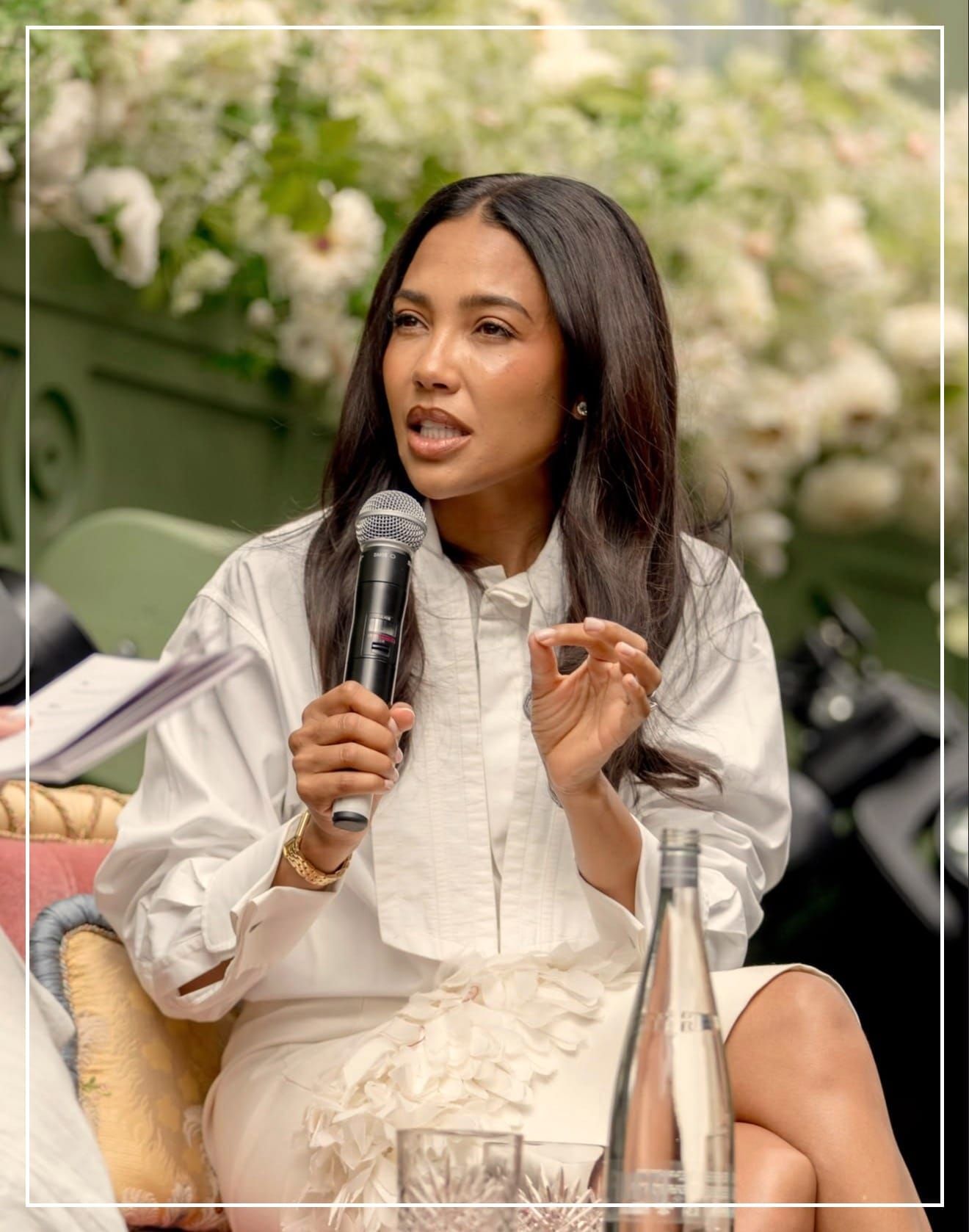
From an East London paper round to building brands and substantial personal wealth, Emma Grede’s career shows how ambition can become skill, ownership and opportunity.
Emma Grede grew up earning money from a paper round in East London. She went on to cofound Good American, become a founding partner of SKIMS and build a fortune Forbes estimated at $405 million in June 2025. [15]
Her rise is extraordinary. Understanding how she built it brings that achievement within view: years learning to negotiate, assembling partnerships and recognizing opportunities in the customers fashion overlooked.
At Good American, the problem clustered around sizes 14 and 16. Emma Grede told Teen Vogue that return rates for those sizes were 50 percent higher than for others. The company investigated the change between its straight-size and plus-size patterns, recruited women for fit research and introduced size 15 in 2018. [7]
A missing size is a useful place to begin her story. It brings the conversation down from celebrity partnerships and success advice to something a customer can feel: whether the product actually works.
Grede’s public profile now includes Good American, SKIMS, a book and Aspire with Emma Grede. But the business underneath that visibility deserves a closer look. Her path runs through fashion-show sponsorships, an agency acquisition, an expansion she reversed and repeated decisions about whose needs a company should take seriously.
Before the boardroom, a household budget
Grede grew up in Plaistow, East London, the eldest of four children raised by a single mother. She earned money from a paper round while still young and later left the London College of Fashion without completing her studies. Her route into business was practical and uneven, rather than a straight progression through elite credentials. [3]
In a 2026 Boardroom interview, she remembered her mother working through a line-by-line household budget. Knowing what groceries and electricity cost gave money a concrete meaning. Her own earnings could buy magazines and train fare into the West End, where more work might be available. [2]
That detail complicates the usual account of someone simply wanting to be rich. For a child watching the arithmetic of a household, money can mean room to move. A train ticket is small, but it can change which opportunities are within reach.
Fashion supplied the fascination. Grede told Fashionista that she collected advertisements in brand-specific files. Yet she did not see herself as the designer. She recognized that she could work around creative people and help make their work commercially possible. [1]
The apprenticeship was in contracts
Her early work included assisting a fashion-show producer and moving into sponsorship. The job connected designers, brands and the money required to put on a show. She developed an aptitude for negotiation and assembling partnerships, then built ITB, an entertainment-marketing agency. [1]
There is an important business education inside that progression. A sponsorship deal forces several questions into the same room. What does the brand want? What can the creative partner deliver? What does each side believe the audience is worth? Who carries the responsibility if the promise is not met?
Grede was working at that intersection before she became a widely recognized business personality. By the time Good American arrived, celebrity collaboration was an area of professional experience.
Rogers & Cowan announced its acquisition of ITB Worldwide in May 2018. The agency would retain its name and join the Octagon Sports and Entertainment Network. The transaction’s financial terms were not disclosed. [4]
The acquisition marked a significant milestone in a career already expanding into consumer brands. By then, Good American was underway, and Grede had experience both assembling deals for clients and building a brand of her own.
The agency years also included a decision she had to reverse.
In a 2019 Shopify interview, Grede described opening offices in New York and Los Angeles, then shutting the Los Angeles office after making the wrong decision. She presented the experience as part of learning through action and correction. [5]
Closing an office is a different kind of lesson from losing a pitch. Expansion creates obligations before it produces a dependable return. A founder has to decide when persistence is justified and when continuing would compound the mistake.
Her account offers a counterweight to the idea that successful entrepreneurs possess unbroken certainty. Here was someone who could build an agency, make a bad expansion decision and still develop a business another company wanted to acquire.
The useful question is how you recognize a mistake while there is still something worth protecting.
Good American made inclusion an operating decision
Good American launched with Khloé Kardashian on October 18, 2016, offering denim in sizes 00 through 24. Its much-repeated first-day milestone was $1 million in sales. That figure describes sales, not profit or Grede’s personal earnings. [6]
Kardashian’s reach was a powerful advantage. Grede’s previous experience helped her understand what such reach could do. Still, the product proposition had to give a customer a reason to stay after the launch.
Grede told Fashionista that Good American required Nordstrom to carry its full size range together in the premium-denim section, rather than separating larger sizes elsewhere. [1]
That choice made the promise tangible at the point of purchase. A campaign can celebrate a woman while a store still directs her away from the main collection. Requiring the range to sit together asked the retailer to change the shopping experience.
There were commercial consequences. In the Shopify interview, Grede said Good American had lost potential retail relationships over unwillingness to support the full range. She also described the manufacturing and shipping costs involved in making larger garments, explaining that inclusion had been built into the original business plan. [5]
This is where the story becomes more demanding than a statement about representation. A principle affects inventory, cost, distribution and which accounts a company is prepared to decline. To understand the business, follow those decisions.
Size 15, and the limits of listening
The size-15 response shows what that commitment looked like after launch. The team treated return data as evidence of a fit problem and used customer research to develop an additional option. [7]
A return is expensive, but it can also be informative. It records the distance between what someone expected and what the company delivered. Looking for patterns creates a chance to improve the product rather than blaming the customer.
Listening did not make every decision correct. Grede and Kardashian told Entrepreneur that following demand for rigid denim led them toward a product that did not suit their customers as well as expected. They had to reconsider how to adapt the trend. [6]
The two episodes belong together. Customer feedback can reveal a need; it does not relieve a company of judgment. The work is deciding what to change, testing the answer and accepting when the first attempt falls short.
Building beyond Good American
Grede is Good American’s cofounder and CEO, and a founding partner of SKIMS. In her Boardroom conversation, she described her SKIMS contribution through product development: translating Kim Kardashian’s vision into products. She also explicitly distinguished FRAME as her husband Jens Grede’s business, rather than her own. [2]
Product development gave her a way to contribute her experience to another founder’s vision. It also extended her career beyond leading a single company.
Her ventures also include Safely, the cleaning-products brand she cofounded. [8] In January 2025, the NFL announced Off Season with Grede, designer Kristin Juszczyk and Fanatics, bringing Juszczyk’s distinctive fan-apparel approach into an officially licensed collection and established sales channels. [12]
Off Season brings her experience into sports apparel: a distinctive creative idea, an audience and partners with the licensing and distribution to bring the collection to market. It is another setting in which to apply the partnership skills she developed early in her career.
Emma Grede’s estimated net worth
Forbes estimated Emma Grede’s net worth at $405 million as of June 3, 2025, attributing roughly three-quarters of that fortune to her stake in SKIMS. This is a dated estimate of wealth, including private-company equity, rather than cash in the bank or an independently verified current balance. [15]
The scale of that achievement deserves to be recognized. The young woman earning money from a paper round went on to build an agency, lead a consumer brand and participate in businesses with substantial ownership value. Her career offers a powerful example of how commercial skill can grow into financial independence and a wider range of choices.
For someone at the beginning, the destination may look distant. The earlier steps are easier to recognize: develop a skill, become dependable, learn how a deal works and look for an opportunity to own part of what you help create. Those steps do not guarantee her outcome, but they give ambition somewhere practical to go.
Start With Yourself: ambition on her own terms
Start With Yourself: A New Vision for Work & Life was published in the United States by Avid Reader Press on April 14, 2026. Its publisher describes a framework for questioning inherited assumptions about ambition, money and work, alongside accountability and recovering from failure. Grede calls those inherited assumptions “Old Thoughts.” [8]
Read alongside her business history, that premise raises a practical question: which rules have you accepted without examining them? In a company, the answer might concern which customers deserve a full product range. In a career, it might concern what kind of person is entitled to negotiate or lead.
An authorized excerpt challenges expectations that mothers should perform perfectly at home and work simultaneously. [9]
There is a liberating idea here: ambition deserves a deliberate place in your life. Making room for it means choosing priorities, asking for support and deciding which expectations you are willing to carry.
Readers will have different resources and responsibilities. The useful starting point is to ask what greater agency could look like within their own circumstances.
In her book conversation with Oprah Winfrey, Grede described severe dyslexia and the difficulty of writing. She explained that she needs numerical information explained to her before she can recognize the patterns and relationships within it. [10]
That is a more specific leadership detail than a general claim about confidence. It describes a way of working: understand how information becomes usable to you, then build the communication and support around that.
It also gives the book another dimension. Someone publicly offering a framework for self-direction was undertaking a task she found unusually difficult. The message carries more substance when the difficulty remains visible.
In her own words
Emma Grede introduces Start With Yourself and the ideas behind her book.
Finding her own audience
Aspire with Emma Grede extends her public work into interviews and direct advice. Her official site describes conversations about business, money, careers and personal decisions, including episodes with Amina Muaddi and Sofia Franklyn that address ownership and business partnerships. [11]
For TTC, the interesting shift is the relationship with the audience. An agency helps a client communicate. A consumer brand serves a customer. A book and recurring show let the executive develop an ongoing public conversation in her own name.
For listeners drawn in by a short clip, those longer conversations offer room to explore the decisions, setbacks and ambitions behind a career.
Who else gets shelf space?
Grede’s work as chairwoman of the Fifteen Percent Pledge connects her business career to a wider question of access. [13] Founded by Aurora James in 2020, the organization asks retailers to commit shelf space and purchasing power to Black-owned businesses. [14]
A place on a retailer’s shelf can give a business the opportunity to reach customers and grow. Supporting access for other founders extends the conversation from individual achievement to who gets the chance to build next.
Why This Matters Now
The book and podcast make this a useful moment to study the career behind the advice. Grede is increasingly visible as someone explaining how to build a life and business. Her earlier decisions provide a way to assess those ideas.
Look at the office she closed. Look at the retail relationships she said she declined. Look at the returned jeans that prompted a new size. These examples put ambition under pressure, where a choice has a consequence and a company has to respond.
For anyone building something, the transferable work is specific: acquire a skill people need, learn what the customer is experiencing, negotiate for the proposition you intend to deliver and revise decisions when the evidence changes.
The Tall Cotton Coda
There is a reason to keep returning to that missing size.
A woman bought something that did not fit. Enough women had the same experience that the company could see a problem. Someone then had to decide it was worth solving.
The distance between that East London paper round and the businesses Emma Grede helped build is extraordinary. It deserves to inspire. Looking closely at the contracts, corrections and product decisions gives that inspiration a place to begin.
You do not need to have her destination in sight to take your own ambition seriously. Start with what you can learn, what you can contribute and what you might one day own.
Notes & Sources
[1] Fashionista, Dhani Mau, May 24, 2018. Early career, sponsorship work, ITB and Good American.
[2] Boardroom, October 5, 2026. Interview with Rich Kleiman: childhood budgeting, SKIMS role and FRAME distinction.
[3] BBC Radio 4, Desert Island Discs, Emma Grede. Transcript hosted by Podcast Rex: upbringing and education.
[4] Rogers & Cowan, May 10, 2018. Acquisition announcement; terms undisclosed.
[5] Shopify, Jason Buckland, updated December 5, 2019. Interview: office closure, retail refusals and manufacturing economics.
[6] Entrepreneur. Good American cofounders on launch sales, customer feedback and product mistakes.
[7] Teen Vogue, Avery Matera, September 19, 2018. Size 15 and the return-data problem.
[8] Simon & Schuster / Avid Reader Press. Start With Yourself: official book description and US publication details.
[9] Marie Claire, April 15, 2026. Authorized Start With Yourself excerpt on motherhood expectations.
[10] Aspire with Emma Grede, April 30, 2026. Oprah book conversation; transcript hosted by Podscripts, especially around 57:27 onward.
[11] Emma Grede official site. Aspire episode descriptions and current book information.
[12] NFL, January 7, 2025. Off Season launch with Kristin Juszczyk, Emma Grede and Fanatics.
[13] Fifteen Percent Pledge. Emma Grede biography and chairwoman role.
[14] Fifteen Percent Pledge. Organization history and Aurora James’s founding campaign.
[15] Forbes. Emma Grede profile: $405 million estimated net worth as of June 3, 2025; SKIMS stake reported to account for roughly three-quarters of her fortune.
Share the story